Showing posts with label LTE-TDD. Show all posts

Wednesday, 6 March 2013

4G phones in India

As Indian operators are slowly but surely laying out 4G network, they face one specific challenge which we identified earlier. There are few 4G [LTE-TDD] based phones in the market. Most of the western phone vendors have started supporting LTE-FDD looking at European and US market. Indian operators like Reliance and Airtel realized that unlike GSM and 3G phones, they cannot depend on the market for the supply of 4G phones. They have to provide their consumers 4G phone that will work with their 4G network and that too at affordable cost. So, each operator is tying up with specific phone vendors to provide 4G phone for their consumers and predictably all the phone vendors that are being tied up, so far, are Asian. While Airtel tied up with ZTE and Huawei earlier, Reliance is tying up with Samsung to provide the 4G phones for its consumers. Mukesh Ambani's RIL announced today that it tied up with Samsung to bring branded 4G phones at Rs 5500. Albeit none of these phones support VoLTE [please check my previous post for more details on VoLTE] as yet.
ZTE's android based 4G phone. specs here
It is interesting that while western phone makers are lethargic to bring out LTE-TDD phones, all Asian phone makers are scampering to launch more 4G phones this year.
Last week in Mobile World Congress, China Mobile showcased 4 LTE-TDD phones, from brands such as HTC, LG, Huawei and ZTE[news report]
We should expect more announcement on 4G phones and deployment in the upcoming 4G World conference in India, scheduled on April at Gurgaon. You can check their website for more updates at http://www.4gworldindia.com/
Incidentally Videocon took a different path for 4G. While big operators in India picked up Chinese vendors for Equipment, Videocon tied up with Nokia Siemens for 4G-based broadband. "We intend to engage Nokia Siemens Networks as our Technology partner for our 4G network roll-out in the country Videocon Mobile Services Director and CEO Arvind Bali said in a statement. He said that going forward, the company will look to provide data service (internet) experience including Video Chat, Mobile TV, HD (high definition) TV content, digital video broadcasting etc,over its 4G network. [news report]

Tuesday, 19 February 2013

India one step closer to pan-India 4G adoption


Reuter reports that Indian Government has taken a decision this Monday to allow all the wireless broadband airwave holders to support voice over 4G by paying a one time fee of $306 million. This will remove the last regulatory hurdle to deploy LTE as the technology for both data and voice. Three large players, Reliance, Vodaphone and Airtel are expected to go full-steam in this year with LTE. For voice however, technology is still in the catch-up mode. Ideally, with LTE, the bearer protocol for the voice was expected to be voice over LTE. But voice over LTE still has some distance to cross before the technology can mature to substitute existing circuit-switched voice service provided by GSM. This is a case where market is moving faster than the technology.  For countries like India, who do not have large technology R&D investment in LTE or 3G wireless, market driving technology is in fact a boon. India does not need to follow a particular country (e.g. USA) or a technology, it has the freedom and latitude to follow the best of the breed. Fact is although GSMA adopted voice over LTE as the bearer protocol service for LTE technology in 2010, world's first ever commercial deployment of voice over LTE happened only in last quarter of 2012 when SK Telecom of South Korea launched the service with Ericsson and LG as the technology partner in September, 2012 [news announcement].
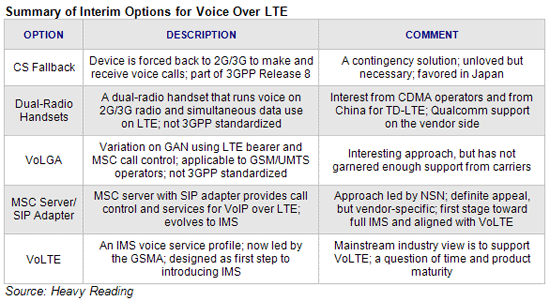
Operators in US and Europe have been trying with alternatives to voice over LTE as an interim solution but none of them match the spectral efficiency that VoLTE can provide. Heavyreading article provides a good summary on the alternatives that operators are trying for providing voice service over LTE. I have pasted their summary table here for those who are hard-pressed for time.
 As one can imagine, lack of clear choice impacts not only the network readiness but the handsets too. Huawei spokesperson stated last year that the aim is to bring voLTE enabled handset by 2013. Operators definitely want a single IP-based voice delivery solution, for LTE, which can simultaneously deliver voice, video and data so that it becomes credible deterrent against existing VoIP service like Skype. So there is no doubt that all the handset manufacturers would focus their resources to bring out fully voLTE capable handsets but challenge of interworking with multiple evolving technologies can be a serious hurdle. The hurdle can be somewhat reduced if the handset manufacturers work together. For a service to function smoothly, handsets from different manufacturers must agree on a single common procedure for voice call transfer, or voice/video call switch or roaming service. Some of them are part of the standard, but many are design artefacts which handset manufacturers must settle between themselves. For the first generation voLTE smartphones [from LG or ZTE] call switch quality appear to be satisfatory but power consumption appear to be on higher side [source]. Fallout of all these is, we may have to wait till the end of 2013, to see fully functional voLTE handsets from leading handset manufacturers like Samsung, Nokia or Sony-Ericsson. Indian operators have another hurdle. Indian operators have adopted LTE-TDD, as opposed to LTE-FDD that European operators adopted, following China and other Asian countries [check my previous posts]. This may mean that Indian operators may have to depend on Huawei or ZTE to bring the first set of handsets for Indian LTE voice/video consumers.Incidentally Airtel last year launched LTE multimode based Huawei smartphone, in India, that actually use 3G CS fallback alternative for voice calls [first alternative in the table]. In other words they do not support VoLTE yet.
So what does all these mean to you? If you are a technology enthusiast looking forward to buy a 4G smartphone, it means that you perhaps would like to wait till the end of the year when voLTE enabled handsets will be launched. Otherwise you are quite likely to replace your handset with another 4G handset in 2014.

Wednesday, 4 July 2012

Nokia in 2012: a luminous end of a glorious past?

Recently I walked into a local cellular phone shop and asked for a not too inexpensive but sturdy phone set. The salesman asked me if I am looking for a smartphone. I said that I have nothing particularly against smartphone as long as it is stable and inexpensive. Fact is I have personal allergy to all these marketing terms especially when everyone knows that there is nothing smart in a smartphone. The salesman gave me too sets, one Samsung 'Guru' that cost around Rs 1800 and another Samsung Galaxy SII, that costs around Rs 17000. Being a majorly Nokia user so far, I was a little hesitant. "No Nokia set?", I asked.
He said, "Sir, we do have Nokia set but my honest advise is that you do not buy Nokia. The Nokia phones are not like those in past, quality dropped drastically."
"Even for the basic sets?"
"Yes, Sir, even for the basic sets, we get so many complaints every month these days that we warn customers upfront; after that, of course it is their choice if they still like to buy Nokia set".

Yesterday, a friend of mine called me and told that he needed to replace his old handset with a new one and asked me if I had any suggestion for him. I told him, quite unconsciously that he should consider samsung or Sony-Erisson or blackberry models but not Nokia.
But I am sure I was not the exception. Nokia clearly lost its customer loyalty drastically in last few months. It is said that problems do not visit alone. If the customers and shoppers complain about detoriating quality of Nokia phones, the market is exceptionally pessimistic about Nokia's future. Rating agencies like Moody, S&P have downgraded Nokia's credit rating to junk status.
For last one year, we have been witnessing the impact of Nokia's CEO's landmark direction change and one does not need to go too far to sense how well Nokia is doing. Internet is abuzz with reports about how Lumia turned out to be a dud, how Nokia lost 52% of market share in just few months, how Mr. Elop, the ex-Microsoft Nokia CEO has wasted billions of dollar (e.g. in Lumia campaign) and made Nokia taste loss in last quarter by taking successive wrong decisions. Now it is debatable if Nokia would have fared better had Mr. Elop not taken those bold decisions. Fact is symbian was a dying elephant albeit 57% Phones in the market had symbian OS when Mr. Elop took over. People blame that, between 2003 and 2008, 'rather than spend its resources on building a next-generation software ecosystem—an OS that depended on novel interfaces and sensors, that allowed for outside development, that offered a brilliant user experience—the company “managed down” its cash by paying huge dividends and buying back its shares." During that period, Nokia spent 27 billion euros in dividend and share buy-back - a clear sign of organization trading long term engineering future with short-term stock appreciation. Were Mr. Elop's manoeuvre successful, Nokia could truly turn around and challenge iPhone dominance riding high on Lumia and Microsoft WP7.

Summary of the present situation

1. Nokia wanted to cannibalise Symbian with Microsoft OS but market cannibalised Nokia smartphones with Samsung and others. Android proved to be much stronger market force than WP7.
2. Nokia's deteriorating engineering focus had its toll in the low-end basic phone category too; customers are moving to alternatives to Nokia sets. People expect mobile phones to be lot sturdier than PC. Call-drops due to poor quality of handset cost customers money and fact is Samsung low-end phones are lot more stable compared to present Nokia models.
3. While Apple, Samsung, HTC have successfully established themselves in the tablet space, Nokia missed the bus altogether.
4. Nokia's network division, once a very strong market force is also struggling against Chinese competition from Huawei and ZTE, even after merging with Siemens Network.

It is interesting that all the present predicament of Nokia are hinged on single failure: its successive unsuccessful attempts to secure its platform strategy.

Is this the end of  a Glorious past?

Many argue that from where Nokia stands today, it is very difficult for it to get itself out of the mud and only viable option left is buyout by Microsoft. Although Nokia's past and stack of IP would be valuable asset for Microsoft, it is very likely that a direct buyout would bring the combined net worth further down, effectively eroding the value of Nokia to zero. A better path would be if Microsoft lets Nokia find its survival path rather than direct buy-out.
But then Nokia needs to change in many front. It must figure out its strategy for low-end phones where stability and robustness count higher than features. On the high-end segment, it has to open itself for multi-platform strategy like HTC and Samsung rather than firing all guns on Lumia. That should help Nokia to find its competitiveness against Samsung and HTC.  But above all, Nokia must find one software that its engineering should focus wholeheartedly.  Something like a platform-independent Nokia mobile software that can work seemlessly on both Android and Microsoft Windows. Alongwith that a great developer SDK could be a game changer. It could help Nokia to capture large unorganised app ecosystem making the Nokia Mobile software the de-facto platform for mobile app development. That would help Nokia to integrate tablets into its product portfolio like Apple and Samsung. On the technology front, using its strength in wireless technologies, Nokia could focus to bring the first stable 4G (LTE) smartphone that can seemlessly transition from 3G and 2G networks.
But then that would take time and lot of patience from the market. Question is if Nokia has so much time!
 Last year we witnessed Motorola going down the same trajectory ending with Google's buyout. Will 2012 witness fall of another hero of Telecom yesteryear? Negativity brings more negativity but gratification of 'I told you so' is too pale to such a loss if that happens.
A company that in its more than 150 years of history changed its core business 17 times to remain relevant and successful, if turns itself to such an end, it is not only painful, it is demeaning too.

Tuesday, 10 April 2012

Finally India figures in 4G map

Yesterday, Airtel launched 4G service in Calcutta, first time in India. When I wrote my post, "will India leapfrog to 4G?" few months back, little did I imagine that it will be so soon, although it definitely gives a sense of pleasure to see it coming in real. Airtel picked the TDD-LTE as the technology and ZTE, China as its technology partner. With Airtel already adopting it, we can expect Reliance to follow the suit some time this year. That would make LTE-TDD the technology of choice for 4G in entire south Asia with China taking the lead. It also looks like that China's dominance in 4G technology space will be complete. Why Airtel chose ZTE:
  • ZTE says it is a leader in developing LTE technologies and has applied for 381 essential patents (EPs) for LTE standards, which account for approximately seven percent of the total number of EP applications globally.
  • ZTE has won 30 contracts for LTE commercial application and has deployed test networks in cooperation with more than 100 operators across the globe.
  • To date, ZTE has signed three contracts related to deploying and upgrading 3.5GHz TDD-LTE networks in Asia-Pacific and Africa.
  • ZTE is a major global vendor driving the use of 3.5GHz and 3.6GHz bands. The use of these bands has now been approved as an industry standard by the 3rd Generation Partnership Project.
  • ZTE also has helped operators like Japan's Softbank, Sweden's Hi3G and China Mobile successfully deploy TD-LTE networks.
  • and ZTE is dedicated to becoming the world's No. 1 TDD-LTE brand. According to the World Intellectual Property Organization (WIPO), ZTE filed for the most PCT patents of any company worldwide in 2011 with 2,826 filings.
Sounds great! Since the number of 4G handsets available in India is quite low at the moment, Airtel is launching dongles (made by ZTE) with the SIM cards built in. The tariff also looks quite reasonable compared to existing ADSL+ or 3G broadband rate. Presently they have three plans:


plan namerentals (per month-INR)free quota (GB)speed post FUP (kbps)
breakfree999 6128
breakfree max 13999128
breakfree ultra 199918128

Airtel says they would be starting pan-indian broadband service soon. Although theoretical limit for 4G service is 100 Mbps [download] and 40 Mbps [upload], one cannot reasonably expect that speed with Airtel at present; 128kbps for that matter is a good starting point.
What made Airtel launch the service so early? It appears that world, primarily led by Chinese technology developers, are moving for fast 4G adoption. This Financial report article said that China telecom has decided to accelerate its 4G deployment. Deployment also became more cost-effective with average cost coming down to $10K for converting a 3G Base Station to 4G Base station. China telecom has invested most of all the telecom operators on 4G trial so far. They have good reason to accelerate the 4G deployment. But it appears that many countries will be in 4G map before this year ends. Srilanka already is, for example. While European and US operators may be slow with 4G deployment GSA expects that south asia will drive the 4G deployment this year. As per their latest reports there are 300 operators invested in 4G and 347 LTE User devices launched by 63 vendors.
While Network side deployment is going on full-swing, one area that concerns the market is there are not many 4G handsets available. Handset technology is little more tricky since it involves voice, video telephony and roaming over 4G and probably 3G and standardization effort continues to be an ongoing process. However all existing handset leaders are gearing up to launch 4G-enabled smartphone sometime this year looking at both China and India as the major market segment. In fact there is already news  that Apple's iPhone 5 as well as new iPad will support LTE-TDD.
Overall, it looks like, 2012 will be a very exciting year for high-speed mobile telephony and Indian consumers are not going to be left behind.

In case anyone is interested, 4G World Asia is scheduled on 21st May in Singapore

Tuesday, 28 February 2012

will India leapfrog to 4G directly?

All the recent news in the aftermath of cancellation of 122 2G licenses, India's wireless telecom segment looks a bit uncertain. At least two foreign operators publicly stated that they are exiting India. However if one looks carefully, there are more positives than the negatives. The verdict makes every stakeholder more careful and focused on the long term. Also DoT's Telecom spectrum handling is expected to be more transparent and consistent across. The fact that India's mobile population is growing and has much younger user-base, makes it more attractive to the operators compared to other markets. Also it appears that India's mobile users are getting more interested to use their mobile phone for internet access. That will eventually make mobile data traffic way higher that voice traffic which opens a multiple avenues for new revenue generation compared to plain voice traffic.
  As per the September, 2011 data from TRAI, India's mobile subscription base stands at 907 million and most of them are on the voice network. A large chunk of this userbase is expected to upgrade themselves to smartphones and are expected to generate more data traffic than voice.
With 2G network still growing in India and are expected to continue the trend for another year or so, India's challenge is to allow the 2G operator continue generating revenue while preparing the network for high speed wireless broadband.
In 2010, India had the first auction of Broadband Wireless Access spectrum. The 4G Auction carried on the back of 3G Auction saw 5 winners: Infotel (22), Qualcomm (4), Bharti (4), Tikona (5), Aircel (8) and Augere (1) excluding state-owned BSNL and MTNL. It is interesting to note that top 3 winners are new operators. More interesting aspect is that almost all of them signed up for LTE technology. Now LTE is the most dominant 4G technology with an adoption slowly encompassing the whole world, as per the latest report from GSA (Global Mobile Supplier Association).
For record, GSA report from January, 2012 tells that 285 operators globally are investing in LTE. And DailyWireless reported last year that all the 4G auction winners [barring state-owned operators] have chosen LTE-TDD as the technology.
It is particularly important to mention that China too has chosen the LTE-TDD as the technology for their 4G network. With World's two most populous nation picking LTE-TDD, it is quite apparent that LTE-TDD will enjoy the dominance across world.
What is LTE-TDD
LTE-TDD or Long Term Evolution - Time Division Duplexing [for unpaired bands] was standardized in 3GPP Release 8 as the fourth generation cellular wireless technology. While the back-end is all-IP nework [unlike 3G], LTE comes in two different Radio access variants: Time Division and Frequency Division. TDD variant is asymmetric [between uplink and downlink speed] and therefore promises higher spectral efficiency [i.e. more bits per frequency channel]. Since it uses single carrier frequency, it is also relatively simpler to deploy. Recent trials from Ericsson, Huawei and others claim to reach downlink data rate of 100 MBPS, making it ideal for IP-TV type of broadcast service. With dynamic asymmetric configuration the downlink rate can be  4-9 times faster than uplink rate making it adaptable for different types of data services.
The architecture is made such that an operator can have both TD and FD network helping immensely to retain CAPEX investment made in either of the technologies. 3GPP identified 30+ frequency bands so that spectrum availability does not become a constraint. It can interwork with 3G technologies which means migration from 3GPP is smooth. Since LTE can be deployed over older GSM/GPRS bands, it can also become the upgrade technology for 2G. However that will require complete overhauling of network infrastructure.
There is one chink though, 3GPP did not define the voice technology for LTE. To address the gap, GSMA adopted the GSMA voice over LTE initiative that tries to define VoIP service over 3GPP standardized IMS [IP Multimedia Service] although that service is not part of LTE standard.

Salient points about LTE-TDD


  • Technical Standards part of 3GPP release 8
  • High theoretical peak user rates of 170 / 54 Mbps (downlink/uplink, 20 MHz)
  • Asymmetric uplink/downlink rates to match traffic types for good efficiency
  • Peak spectral efficiency as good as competitive standards e.g. WiMAX
  • Network infrastructure compatible with LTE-FDD
  • Voice over LTE standard is being developed by GSMA
  • emerging as the most dominant 4G technology as per the operator adoption is concerned
Migration Path
Migration path from 2G to 4G can be through 3G or bypassing 3G depending on how much the operator is invested in 3G and how many subscribers have adopted 3G. Given that India is lagging behind other countries in 3G adoption, it probably could leapfrog to 4G directly since in India 4G band is allocated far outside the GSM/GPRS band. It is interesting to note that both China and India have allotted the 2.3 GHz band [3GPP band 40] for LTE-TDD service. It would not only save the operator CapEx of 3G infrastructure, it also will be operationally simpler with 4G deployement requiring new model of handset.
Incidentally China Telecom is the first large provider to commit itself to LTE-TDD. In India TRAI is recommending LTE-TDD for femtocells. Femtocells are very small cells, with a diameter of few meters, recommended for wireless broadband access in urban areas.
It's still far by at least one and half years
While the commitment to the technology is quite strong and trials in different parts of the world are very promising, it also should be noted that commercial availability of this technology [both network and handset] is still one and half years farther making it all the more attractive choice for leapfrogging especially for those operators who have a very small 3G footprint. In the meantime, if you are buying a smartphone try not to spend a lot of money since you may need to replace it soon!
Further Updates
There was one aspect that I intentionally did not touch upon. India's Telecom Policy 2011 draft [to be published this April] did not mention about DoT approach on 4G. As if to answer that yesterday Mr. Kapil sibal announced that further auction for 4G is to happen this year. It is to be noted that BSNL has surrendered their 4G spectrum [that was allotted to them in 2010] to Govt. couple of months back. Govt. also can refarm unallotted 2G and 3G spectrum for 4G which means that there are enough spectrum available to launch 4G service.
Update from March, 6, 2012:
Govt. decided to refarm 700 MHz spectrum for 4G service, pooling up more spectrum for 4G auction.[ Report: http://www.thehindu.com/todays-paper/tp-business/article2965040.ece]

From independent standpoint, right approach should be that Govt allot unified licenses to the operators and auction spectrum without association specific generation of technologies and let the operators decide which band they want to use for 2G or for 4G. To protect 2G investment of new operators, Govt is very likely to continue bar roaming in 3G and 4G for next couple years but eventually all technologies will merge to 4G with unrestricted roaming across circles and technologies [i.e. 2G/3G/4G]. That will take some time but handset manufacturers also need some time to build truly multimode [2G,3G,4G] handset. In summary, India's cellular wireless segment is going to be exciting for at least next four years.