Comparison between India and China is the most hotly debated topic (at least) among Indians after Pakistan-India debate lost the steam few years back. I did a comparison almost a year back in this blog [2010 July posts] and quite coincidentally Amartya Sen wrote in many papers in about a week or two after that, as a clarification of his standpoint on this issue. Obviously he was being asked the same question in many forums around the globe.
After almost a year, we still have reasons for revisiting this topic. In my mind the reasons are 1. both China and India published their provisional census data, 2. we have latest business data coming out of China and 3. Amartya Sen wrote again on the topic in NY times! [look at the bottom of this post for the link.]
Comparisons are always made on certain parameters and choice of those parameters are crucial; the parameters have to be relevant, objective and useful. There is no point in comparing culture or happiness quotient here for they do not provide any objective basis of comparison. However, population and its growth, literacy [for it gives an indication of skilled labour strenght], revenue, GDP make good parameters for comparison [Let's skip the defense now]. So let's look at our recent data.
Population:
China: 1,339,724,852 India: 1,210,193,422. India is still around 130 million short
Decade growth rate:
China: 73.9 million (5.84%) India: 181 million (17.64%). China is in much better stage.
Literacy (%)
China: 95.92 India: 74.04
Higher literacy almost always indicates better preparedness for skilled jobs and therefore higher productivity.
Economy
GDP Ranking
As per 2010 data, China ranks 2nd [with around US $5.8 trillion]
and India ranks 10th [with US $1.5 trillion] if you use market currency conversion rate.
A better approach is to use Purchasing Parity Power. However the PPP calculation pulls India a lot closer to China. As per the 2010 PPP-based list, China continues to rank 2nd (with US $10 trillion) but India moves up to 4th rank with US $4 trillion GDP!
Growth
Asian Development Bank's 2011 outlook report projects
China's GDP for 2011 : 9.6% [down from 10.3% in 2010]
Inflation Rate for 2011: 4.6% [up from 3% from 2010]
Compare that with the following projection
India's GDP for 2011: 8.2% [down from 8.6% in 2010]
Inflation rate for 2011: 7.8% [down from estimated average of 9.2% in 2010].
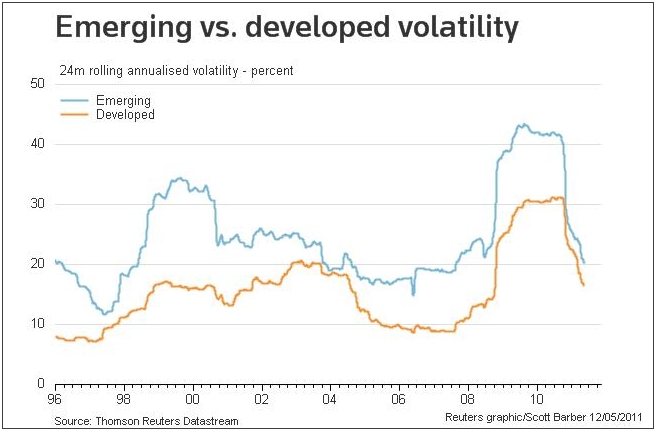
Evidently inflation is eating away many benefits of growth. ADB report suggests that inflation, by impacting the poor section of the country more harshly, in effect is increasing the rich-poor divide in the country. China on the other hand has fared much better in distributing equity [we have covered this in my earlier post]. We all know that China's economy has surplus in almost every aspects with a huge cash reserve and export surplus with almost every other country. Worth noting that India's export deficit to China increased to US $11.4 billion this April although India's export to China increased by 11.7% since last April. China's unequalled growth in manufacturing sector has been one of the strongest drivers for strong export oriented growth. However Chain's domestic market is not too bad either. One of the very recent feats that China achieved is that it became the world's largest market for automobiles this year pushing US aside.
ADB warns that India's largest challenge for the next few years would be containing the inflation. The warning looks very real for many of the banks in developed countries have started questioning the prospect of mid-term growth for investments in many developing countries with rising inflation.
Look at the following chart from Reuters:
http://graphics.thomsonreuters.com/11/05/GLB_EMVAL0511_SB.jpg
http://graphics.thomsonreuters.com/11/05/GLB_MRGDVVL0511_VF.jpg
If the inflation pressure does not ease, there is a high probability that with the recovery of developed economies, funds will fly back to the developed nations even if the return continues to remain low.
The silver line is that growing intolerance to corruption and increased development focus in India are of late, showing some positive result in India's governance story. As many stalwarts have mentioned, only better governance, increased transparency are the key to better financial efficiency. India is a country with diverse interests and diverse equity, only public participation and transparent governance can fill myriads of lacunae in the equity distribution and thereby emergence of India as a powerful nation. Without economic development of socially weak sections, no nation can realistically aspire to become powerful.
If you are looking for more profound analysis, follow this link to read the article from Dr. Amartya Sen.
Wednesday, 18 May 2011


Wednesday, 20 April 2011
Wonders of brain
Few years back I chanced upon a computer generated image of three-dimensional synaptic map of brain. The subtext commented that the image looked uncannily similar to the universe that we know of with galaxies, super galaxies, nebula spread across light years. While the image looked impressive the comparison did not. With visible matter [that forms galaxies, super galaxies and so on] only constituting 1% of the total mass in Universe, we hardly have a clear picture of Universe. That said, one cannot miss one ironic commonality that brain and the universe both fall in the lowest-precision-human-knowledge category. It is hardly surprising that lion's share of present popular science literature are on either cosmology or neuroscience.
I, being an expert in neither of these fields, find it lot easier to talk about the mysteries with an excitement of a wide-eyed boy who feels no burden to theorize or explain with rigour, the 'why' and 'how' part of intricately complex pieces of creation.
So it amazes me that human brain in average has about 100 billion (1011) neurons and 100 trillion(1014) synapses. It also is exciting to know that from the perspective of evolution, neocortex is the latest addition in the brain structure and only mammals have that. Neocortex is the most complex part of brain and is made up of 6 layers that actually is responsible for processing all sensory information, breaking down into canonical patterns that form the 'actionable memory'. In human, 90% of cortex is essentially neocortex. Science also educated us that there is a 'slow path' and corresponding 'fast path' for decision making in brain. Slow path goes through cortex and typically is more precise compared to fast path. We also know now that amygdala plays central role in all our emotions and it is tightly connected to cortex. With so massive and intricate structures in place, initial few years of our development are mostly spent in developing the networks between the neurons. Now what happens if for some reason connections are not established properly, what happens if some structural error happens during the connection development?
Well, possibilities are immense, but our knowledge is very limited. While most are in the realm of speculation, there are few exceptions, like Autism which scientists believe is a clear case where unusual change happens during initial wiring of neurons.
Thanks to the beautifully made movies like, 'Tare Zameen par' and 'Rainman' many are aware of the problem of Autism. For others, Autism is a neurological development disorder that sets off before the age of 3 years. It is characterized by impaired social and/or communication skill, sometimes inability to differentiate left/right or order, repetitive body movement and/or unusual attachment to objects and routines. They typically have problems associated with numbers and language.
While there are no clear winning theories on how and how this disorder happens, a general understanding is it is an effect of lower connectivity in different regions of cortex. Lately fMRI and PET scanning based studies are undertaken but results are far from conclusive. "Oculomotor studies have provided evidence of neocortical dysfunction of the prefrontal cortex and connections to the parietal lobe... Perception is accomplished in the brain by means of a parietal pathway for spatial and motor function and a temporal pathway for identification of objects, faces, and gestures. Anomalies in the amygdala and other structures of the medial temporal lobe have been demonstrated repeatedly in autism spectrum disorders, suggesting involvement of the temporal pathway for visuoperceptual processing."
An interesting observation is that the male-to-female ratio of patients with autistic disorder is approximately 3-4:1 i.e. autism is manifested more in male children. This observation leads to a hypothesis that certain genetic pattern, particularly X chromosome play a role in the development of autistic syndrome, however there is no defining proof for that.
Dr. Baron-Cohen, a leading expert in autism related disorders has a theory. "In the general population, you find that, on average, males have a stronger drive to systemize and females have a stronger drive to empathize. Those are the 2 cognitive processes we've been focusing on to try to understand autism and why it should be more common among boys than girls. We've found that people on the autistic spectrum show an exaggeration of the male profile."
He adds, "when we started working in this area, we set up a model as if these 2 things were independent of each other. But as we've tested more individuals, we've found there's some kind of trade-off, so that people who are good at one tend to be worse at the other. Systemizing is the drive to analyze or construct a system. The key thing is that when you systemize, you identify the rules or the laws that govern that system in order to predict how it will behave." He argues that this is more a male trait and in many cases the parents' brains actually show enhanced systemizing skill.
While there are common patterns demonstrated by autistic child, there are cases where an autistic person develops exceptional number and memory skill. Most well-known is the case of Daniel Tammet. Daniel is born on 31st Jan, 1979 in Britain and is diagnosed as autistic child. While he has autistic traits in terms of his social skill and his obsession with routine, he already has many exceptional feats under his belt.
He calculates faster than a calculator. He speaks many languages. To be precise he speaks almost all European languages including the most difficult Icelandic too. It is said that Icelandic is one of the difficult languages to learn and he amazed the observers by mastering the language in 7 days flat.
In 2004 he set a new record by recalling the value of pi till 22,514 decimal places. He took 5 hours to do that. He says that he does not see numbers, he actually sees them as shapes, colors, textures. He wrote couple of books and the first one, Born on a Blue day, which is his autobiography, has become a bestseller in UK. The Guardian wrote an excellent article on him in case you want to find more. The same article talks about another autistic person who played a complex classical piece on piano after hearing it for the first time though he did not have much piano experience earlier.
The cases of Daniel and many other autistic savants, show us how amazing this fatty stuff inside our skull is. A disability in turn bring out another exceptional mental faculty. Some say that these faculties are available in normal brain too but inaccessible to conscious part of the brain. It is evident that evolution has already gifted lot more to us than we are aware of. It is no wonder that we only use 10% of our brain capacity since most of our so called 'mental exercise' is nothing but reactive and repetitive thought process.
I, being an expert in neither of these fields, find it lot easier to talk about the mysteries with an excitement of a wide-eyed boy who feels no burden to theorize or explain with rigour, the 'why' and 'how' part of intricately complex pieces of creation.
So it amazes me that human brain in average has about 100 billion (1011) neurons and 100 trillion(1014) synapses. It also is exciting to know that from the perspective of evolution, neocortex is the latest addition in the brain structure and only mammals have that. Neocortex is the most complex part of brain and is made up of 6 layers that actually is responsible for processing all sensory information, breaking down into canonical patterns that form the 'actionable memory'. In human, 90% of cortex is essentially neocortex. Science also educated us that there is a 'slow path' and corresponding 'fast path' for decision making in brain. Slow path goes through cortex and typically is more precise compared to fast path. We also know now that amygdala plays central role in all our emotions and it is tightly connected to cortex. With so massive and intricate structures in place, initial few years of our development are mostly spent in developing the networks between the neurons. Now what happens if for some reason connections are not established properly, what happens if some structural error happens during the connection development?
Well, possibilities are immense, but our knowledge is very limited. While most are in the realm of speculation, there are few exceptions, like Autism which scientists believe is a clear case where unusual change happens during initial wiring of neurons.
Thanks to the beautifully made movies like, 'Tare Zameen par' and 'Rainman' many are aware of the problem of Autism. For others, Autism is a neurological development disorder that sets off before the age of 3 years. It is characterized by impaired social and/or communication skill, sometimes inability to differentiate left/right or order, repetitive body movement and/or unusual attachment to objects and routines. They typically have problems associated with numbers and language.
While there are no clear winning theories on how and how this disorder happens, a general understanding is it is an effect of lower connectivity in different regions of cortex. Lately fMRI and PET scanning based studies are undertaken but results are far from conclusive. "Oculomotor studies have provided evidence of neocortical dysfunction of the prefrontal cortex and connections to the parietal lobe... Perception is accomplished in the brain by means of a parietal pathway for spatial and motor function and a temporal pathway for identification of objects, faces, and gestures. Anomalies in the amygdala and other structures of the medial temporal lobe have been demonstrated repeatedly in autism spectrum disorders, suggesting involvement of the temporal pathway for visuoperceptual processing."
An interesting observation is that the male-to-female ratio of patients with autistic disorder is approximately 3-4:1 i.e. autism is manifested more in male children. This observation leads to a hypothesis that certain genetic pattern, particularly X chromosome play a role in the development of autistic syndrome, however there is no defining proof for that.
Dr. Baron-Cohen, a leading expert in autism related disorders has a theory. "In the general population, you find that, on average, males have a stronger drive to systemize and females have a stronger drive to empathize. Those are the 2 cognitive processes we've been focusing on to try to understand autism and why it should be more common among boys than girls. We've found that people on the autistic spectrum show an exaggeration of the male profile."
He adds, "when we started working in this area, we set up a model as if these 2 things were independent of each other. But as we've tested more individuals, we've found there's some kind of trade-off, so that people who are good at one tend to be worse at the other. Systemizing is the drive to analyze or construct a system. The key thing is that when you systemize, you identify the rules or the laws that govern that system in order to predict how it will behave." He argues that this is more a male trait and in many cases the parents' brains actually show enhanced systemizing skill.
While there are common patterns demonstrated by autistic child, there are cases where an autistic person develops exceptional number and memory skill. Most well-known is the case of Daniel Tammet. Daniel is born on 31st Jan, 1979 in Britain and is diagnosed as autistic child. While he has autistic traits in terms of his social skill and his obsession with routine, he already has many exceptional feats under his belt.
He calculates faster than a calculator. He speaks many languages. To be precise he speaks almost all European languages including the most difficult Icelandic too. It is said that Icelandic is one of the difficult languages to learn and he amazed the observers by mastering the language in 7 days flat.
In 2004 he set a new record by recalling the value of pi till 22,514 decimal places. He took 5 hours to do that. He says that he does not see numbers, he actually sees them as shapes, colors, textures. He wrote couple of books and the first one, Born on a Blue day, which is his autobiography, has become a bestseller in UK. The Guardian wrote an excellent article on him in case you want to find more. The same article talks about another autistic person who played a complex classical piece on piano after hearing it for the first time though he did not have much piano experience earlier.
The cases of Daniel and many other autistic savants, show us how amazing this fatty stuff inside our skull is. A disability in turn bring out another exceptional mental faculty. Some say that these faculties are available in normal brain too but inaccessible to conscious part of the brain. It is evident that evolution has already gifted lot more to us than we are aware of. It is no wonder that we only use 10% of our brain capacity since most of our so called 'mental exercise' is nothing but reactive and repetitive thought process.
Thursday, 3 March 2011
If you are using Android phone
Android market share in the mobile OS market has doubled since last year. With Nokia's planned departure from Symbian, the expectation is that it will grow lot faster. However popularity is not without its malice. Recently some news exploded that showed that hackers are particularly targetting Android based smartphones.
Here is one very recent article from Computerworld on how a rogue Android apps is used as Trojan horse to use resources in an Android-based phone. The users wouldn't even know that his phone is sending text messages to premium sites and thereby increasing their bills. It is alleged that many telemarketers are using hackers for this kind of uses. But it looks less malicious compared to this story from CNN. CNN reports today that Google has just pulled 21 popular free apps from the Android Market. According to Google, the apps are malware aimed at getting root access to the user's device, gathering a wide range of available data, and downloading more code to it without the user's knowledge.
However, the report also tells that before Google's corrective action, 50,000 users have already downloaded those apps and thereby got exposed. These users are advised to take their phone to their carrier/provider or the seller and get those devices checked against these malware.
So, if you are Android smartphone user, be prepared for similar attack till Symantec, McAfe launches Android anti-malware suites.
It looks like Android is creating a strong revenue channel for likes of McAfe/symantec.
Here is one very recent article from Computerworld on how a rogue Android apps is used as Trojan horse to use resources in an Android-based phone. The users wouldn't even know that his phone is sending text messages to premium sites and thereby increasing their bills. It is alleged that many telemarketers are using hackers for this kind of uses. But it looks less malicious compared to this story from CNN. CNN reports today that Google has just pulled 21 popular free apps from the Android Market. According to Google, the apps are malware aimed at getting root access to the user's device, gathering a wide range of available data, and downloading more code to it without the user's knowledge.
However, the report also tells that before Google's corrective action, 50,000 users have already downloaded those apps and thereby got exposed. These users are advised to take their phone to their carrier/provider or the seller and get those devices checked against these malware.
So, if you are Android smartphone user, be prepared for similar attack till Symantec, McAfe launches Android anti-malware suites.
It looks like Android is creating a strong revenue channel for likes of McAfe/symantec.
Friday, 18 February 2011
The recent Solar flare
A large solar flare, in astrophysicist's terminology, class X2 flare has happened in last few days and it has already caused serious disruption on electronic communications in China, particularly those that require some assistance from Earth's ionosphere, like direct TV broadcast or Sat-communication. However scientists say that we actually survived from direct effect of the flare this time. http://www.spaceweather.com/ shows some stunning pictures from NASA of a Jupiter-size sunspot that was the reason for this flare.
But scientists do believe there are more to come since Sun is entering an 'active phase'.
Solar flare is caused when high-energy plasma escapes the electromagnetic field on sun's surface and jets out huge plumes of plasma and high-energy photons. If the flare directly reaches Earth's atmosphere, it can burn all electronic equipment that gets exposed. Thanks to Earth's magnetic field, most of those energy gets diverted. However the northern and southern areas get most of the residual effect. In the next few days, Scientists predict that this flare will produce spectacular Northern Lights displays that would be visible in Tasmania.
A series of large solar flare can have a long-term effect on Earth's atmosphere and if you listen to what scientists say, that risk has increased. Why?
Dr. Paul Francis from ANU explains,"The sun has an 11 year cycle so it has quiet periods when you know you are not going to get any (flare) and then the more active periods and it comes and goes every 11 years. We have just been through the quietest period for many decades and it looks like it is coming back towards the solar maximum as it is called. So if we are going to get big ones it will be over the next few years.."
But scientists do believe there are more to come since Sun is entering an 'active phase'.
Solar flare is caused when high-energy plasma escapes the electromagnetic field on sun's surface and jets out huge plumes of plasma and high-energy photons. If the flare directly reaches Earth's atmosphere, it can burn all electronic equipment that gets exposed. Thanks to Earth's magnetic field, most of those energy gets diverted. However the northern and southern areas get most of the residual effect. In the next few days, Scientists predict that this flare will produce spectacular Northern Lights displays that would be visible in Tasmania.
A series of large solar flare can have a long-term effect on Earth's atmosphere and if you listen to what scientists say, that risk has increased. Why?
Dr. Paul Francis from ANU explains,"The sun has an 11 year cycle so it has quiet periods when you know you are not going to get any (flare) and then the more active periods and it comes and goes every 11 years. We have just been through the quietest period for many decades and it looks like it is coming back towards the solar maximum as it is called. So if we are going to get big ones it will be over the next few years.."
Saturday, 12 February 2011
Nokia Mobile Strategy: news is out
As forecasted, Nokia announced their new Mobile platform strategy on 11th Feb and proved my prediction wrong! These are the salient points of the new strategy:
In the hindsight, the decision looks consistent. There are couple of points that I missed to reckon earlier. Tie-up with Google was not going to be win-win for Nokia. Android has proved to be disruptive and Google wants to bring down the Total Cost of Ownership for Smartphones by giving Android free. They are not expecting revenue from selling their OS, they are creating future revenue channel of mobile advertising. They have lot to gain from the tie-up while Nokia has lot to lose. On the other hand windows is not an open source OS, Microsoft wants to earn money from selling their OS and Nokia's revenue source is entirely from selling smartphone. In other words Nokia and Windows are from old business school: earning revenue by selling product. in the scenario of Google's disruptive strategy, both, Nokia and Microsoft have lot to gain by working together. Contrast this with HTC and Motorola approach: they are selling both Android-based and Windows-based smartphones.
Question is this: smartphone volume market is growing and is already quite large in all emerging markets. This market is more price-conscious and more socially active. Can Nokia address that market without joining Android bandwagon?
Well, this time I am going to wait and watch!
http://communities-dominate.blogs.com/brands/2012/03/the-ceo-insane-how-to-rescue-nokia.html
http://communities-dominate.blogs.com/brands/2012/03/brutal-truth-about-lumia-cannot-sustain-even-1-to-1-replacement-of-symbian-windows-phone-strategy-do.html
Fact is Samsung Galaxy [android] has won the market hugely and Nokia Lumia does not figure in the 'to-have' list of average smartphone buyers, neither the Nokia stores are particularly interested to demo it for you even today. So, I guess people decided already but as I said, let's not judge. Let us wait and watch how Nokia CEO manoeuvres from here. Will he finally abandon Microsoft OS? Will he promote both Meego and Microsoft OS? Or will he pull the magic from his sleaves to make Lumia a winner? If one follows his rant about Nokia Sales, it does not look like he has abandoned Microsoft OS as yet.
- Nokia will tie up with Microsoft to use Windows mobile platform as the new primary Nokia smartphone platform
- They will continue to use symbian and expect to sell 100 million more units.
- Meego, the vaunted new platform is expected to become open source mobile OS project.
In the hindsight, the decision looks consistent. There are couple of points that I missed to reckon earlier. Tie-up with Google was not going to be win-win for Nokia. Android has proved to be disruptive and Google wants to bring down the Total Cost of Ownership for Smartphones by giving Android free. They are not expecting revenue from selling their OS, they are creating future revenue channel of mobile advertising. They have lot to gain from the tie-up while Nokia has lot to lose. On the other hand windows is not an open source OS, Microsoft wants to earn money from selling their OS and Nokia's revenue source is entirely from selling smartphone. In other words Nokia and Windows are from old business school: earning revenue by selling product. in the scenario of Google's disruptive strategy, both, Nokia and Microsoft have lot to gain by working together. Contrast this with HTC and Motorola approach: they are selling both Android-based and Windows-based smartphones.
Question is this: smartphone volume market is growing and is already quite large in all emerging markets. This market is more price-conscious and more socially active. Can Nokia address that market without joining Android bandwagon?
Well, this time I am going to wait and watch!
Update from 2012
It's more than a year since the Nokia took that strategic turn to move to Windows. People as expected, have started to evaluate what that decision gave to Nokia. I have few very interesting articles from an ex-Nokia executive to add here:http://communities-dominate.blogs.com/brands/2012/03/the-ceo-insane-how-to-rescue-nokia.html
http://communities-dominate.blogs.com/brands/2012/03/brutal-truth-about-lumia-cannot-sustain-even-1-to-1-replacement-of-symbian-windows-phone-strategy-do.html
Fact is Samsung Galaxy [android] has won the market hugely and Nokia Lumia does not figure in the 'to-have' list of average smartphone buyers, neither the Nokia stores are particularly interested to demo it for you even today. So, I guess people decided already but as I said, let's not judge. Let us wait and watch how Nokia CEO manoeuvres from here. Will he finally abandon Microsoft OS? Will he promote both Meego and Microsoft OS? Or will he pull the magic from his sleaves to make Lumia a winner? If one follows his rant about Nokia Sales, it does not look like he has abandoned Microsoft OS as yet.
Friday, 11 February 2011
Nokia at the inflection point
Sujoy forwarded an article that quoted an internal letter from the CEO of Nokia and I remembered myself commenting months back about Nokia losing the cellphone game. Not that I was prophetic, fact is many people outside Nokia realized that Nokia is missing its steps in the fast-changing handset technology market. For those in hurry, let me try to bulletize what the boss of Nokia has said.
He acknowledged that:
He is going to announce his new mobile strategy on 11th i.e. today. While we must accept that he has got his facts ruthlessly correct, the difficult question is: what option has he got to change the game so late. Nokia is quite badly sandwiched between Apple's iPhone and low-cost very affordable and gizmo-friendly chinese phones.
He said that Nokia's mobile platform is like a burning ship and only way to survive would be to jump out of the ship. He sure knows his turf well. But will he be able to swim over the rough sea after jumping out? We will have to wait for the answer.
But from an outsider's perspective it looks like that he is going to join android platform.
Why?
For an answer, we would have to start with another question instead: what was the reason people loved Nokia phone for? People bought Nokia because 1. it used to be sturdy, 2. it used to be predictable 3. it used to be user-friendly and 4. affordable. You could drop it, it would still work without any fuss. We got used to Nokia's tactile keypad, very intuitive, even a kid could use. Those all changed with the advent of smartphone. Suddenly you have emails, music, camera - all component to use and Nokia's core competency did not cover any of those areas. They brought symbian and made it their central platform. However developer community was not exactly enthusiastic about. To top it all, ever changing web-technologies brought different ways of "connecting people" and those apps were not very symbian-friendly.
In addition, Nokia's internal quality system suffered fast deterioration. With the pressure of integrating external technologies, it had to bank on 'generic' test methodologies rather than 'full-knowledge product verification methods' that Nokia used before symbian. The result was that many of the apps were integrated badly, had many glitches, sometimes unstable and very unintuitive. The product flaws that were almost unheard of with Nokia's early phones, became commonly acknowledged issue. Nokia smartphone crashes too often; may be Nokia thought that, well, MS Windows crashes too and it still sells! But Nokia does not enjoy the almost monopoly that Microsoft enjoys. In short the very durability and user-friendliness that used to be hallmark of Nokia were severely compromised. Customer recognized that lot faster. Enterprise users moved to Blackberry. High-end users who care about the experiences moved to Apple, and low-end customers found cheaper alternatives in Chinese made phones. Chinese OEMs in that sense really brought a disruption in a market that was otherwise controlled by western companies.
Series 60 has become a dead product platform, too cumbersome and complex for fast development. Nokia needs new platform and only platform that has won over its competitors is Android thanks to Google's patronage. Nokia knows that by joining Android bandwagon, they will be able to come back to mainstream. They would be able bring down the development cost quite a lot and could compete Taiwanese, Chinese OEMs credibly. They would be able to focus on their winning MMI which created differentiator for Nokia phones in thr first place. So what I think? I think they are going to announce a tie up with Google and thereby strengthen Google's position as most popular mobile OS. But I also think that I spoke enough!
Now let's wait to see what Mr. Stephen Elop actually unfolds in next few weeks. I, personally believe Nokia will come back, Nokia has proved itself to be a great survivor in the past, they changed their main business 17 times in their long eventful journey so far. They cannot be eighteenth time unlucky..shouldn't be!
He acknowledged that:
- Nokia lost the high-end smartphone game to Apple
- Nokia's symbian strategy failed in delivering its promises
- Nokia is losing at both the mid-tier phone market and low-end phone market
- Nokia was caught sleeping while Android and Chinese OEMs have captured the segment fast
He is going to announce his new mobile strategy on 11th i.e. today. While we must accept that he has got his facts ruthlessly correct, the difficult question is: what option has he got to change the game so late. Nokia is quite badly sandwiched between Apple's iPhone and low-cost very affordable and gizmo-friendly chinese phones.
He said that Nokia's mobile platform is like a burning ship and only way to survive would be to jump out of the ship. He sure knows his turf well. But will he be able to swim over the rough sea after jumping out? We will have to wait for the answer.
But from an outsider's perspective it looks like that he is going to join android platform.
Why?
For an answer, we would have to start with another question instead: what was the reason people loved Nokia phone for? People bought Nokia because 1. it used to be sturdy, 2. it used to be predictable 3. it used to be user-friendly and 4. affordable. You could drop it, it would still work without any fuss. We got used to Nokia's tactile keypad, very intuitive, even a kid could use. Those all changed with the advent of smartphone. Suddenly you have emails, music, camera - all component to use and Nokia's core competency did not cover any of those areas. They brought symbian and made it their central platform. However developer community was not exactly enthusiastic about. To top it all, ever changing web-technologies brought different ways of "connecting people" and those apps were not very symbian-friendly.
In addition, Nokia's internal quality system suffered fast deterioration. With the pressure of integrating external technologies, it had to bank on 'generic' test methodologies rather than 'full-knowledge product verification methods' that Nokia used before symbian. The result was that many of the apps were integrated badly, had many glitches, sometimes unstable and very unintuitive. The product flaws that were almost unheard of with Nokia's early phones, became commonly acknowledged issue. Nokia smartphone crashes too often; may be Nokia thought that, well, MS Windows crashes too and it still sells! But Nokia does not enjoy the almost monopoly that Microsoft enjoys. In short the very durability and user-friendliness that used to be hallmark of Nokia were severely compromised. Customer recognized that lot faster. Enterprise users moved to Blackberry. High-end users who care about the experiences moved to Apple, and low-end customers found cheaper alternatives in Chinese made phones. Chinese OEMs in that sense really brought a disruption in a market that was otherwise controlled by western companies.
Series 60 has become a dead product platform, too cumbersome and complex for fast development. Nokia needs new platform and only platform that has won over its competitors is Android thanks to Google's patronage. Nokia knows that by joining Android bandwagon, they will be able to come back to mainstream. They would be able bring down the development cost quite a lot and could compete Taiwanese, Chinese OEMs credibly. They would be able to focus on their winning MMI which created differentiator for Nokia phones in thr first place. So what I think? I think they are going to announce a tie up with Google and thereby strengthen Google's position as most popular mobile OS. But I also think that I spoke enough!
Now let's wait to see what Mr. Stephen Elop actually unfolds in next few weeks. I, personally believe Nokia will come back, Nokia has proved itself to be a great survivor in the past, they changed their main business 17 times in their long eventful journey so far. They cannot be eighteenth time unlucky..shouldn't be!
Thursday, 10 February 2011
Giant Ring of Black Holes
There are few times, a picture becomes so eloquent that it makes all subtexts entirely unnecessary. For decades, people spoke about blackholes but could not find a proof of their existence so much so that many astrophysicist openly expressed their doubts if blackholes at all exist!. Things changed after Stephen Hawking postulated about blackhole radiation and now with Chandra telescope, science has surpassed that barrier. Now almost every alternate day a blackhole source is getting discovered. But of all those pictures, this recent picture [mapped to recognizable colours] from NASA is a milestone by itself. This is the first time that we saw multiple blackholes in a single frame. Since I cannot copy the image here, I provided the link to the picture below.
Giant Ring of Black Holes
You simply cannot help but be awed by the great masterpiece of the Universe.
Giant Ring of Black Holes
You simply cannot help but be awed by the great masterpiece of the Universe.
Subscribe to:
Posts (Atom)